
Mother’s Day Grief: Fertility Loss and What Lingers
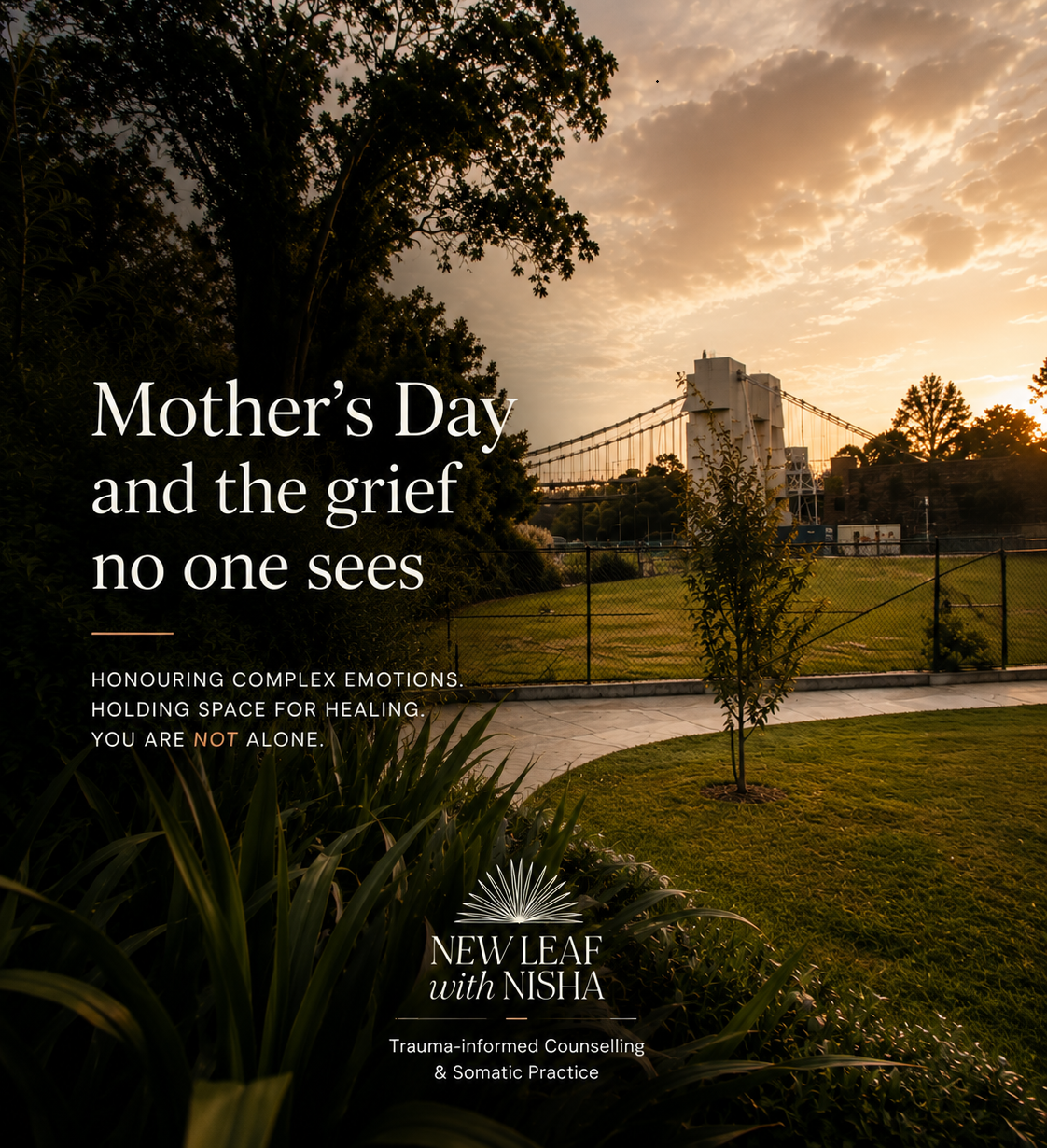
A reflection by Nisha Trivedi, New Leaf with Nisha
Mother’s Day has passed, but for many, its emotional impact lingers.
While the day is typically viewed as joyful and celebratory, it can also trigger grief, fertility loss, reproductive trauma, estrangement, or complex emotions that persist long after.
Having navigated fertility challenges and embraced the role of a non biological mother, I understand from both lived and clinical experience how fertility grief, reproductive loss, and complex family experiences can shape this time of year. Diverse forms of grief can surface at this time, including loss through miscarriage, stillbirth, adoption journeys, estrangement from family, and the absence of mothers or maternal figures for various reasons. Each of these experiences can shape how this day is felt and remembered.
Often, the hardest part isn’t the day itself, but what lingers afterwards.
When the Day Has Passed, but the Feeling Has Not…
In the image (as above) accompanying this reflection, a bridge stretches across the water as the city continues moving in the background.
I revisit this image because it echoes what I witness in trauma-informed and somatic work: life moves on, calendars turn, and people continue forward, but inside, we may still be trying to cross an internal gap.
A bridge does not erase the distance between where we have been and where we are trying to get to. In fact, it acknowledges that the distance exists.
For many, emotionally significant days feel quietly present beneath the surface, and the emotions are not always dramatic or even visible. It’s a sense that something inside is still catching up, grieving, or making sense of what’s been carried over time.
What Mother's Day Can Bring Forward
For some, Mother’s Day can bring forward experiences of fertility loss, pregnancy loss, IVF journeys, or paths to parenthood that did not unfold as hoped.
For others, it may bring up estrangement, complicated family relationships, or the absence of a mother who is no longer here.
For many, it’s not a single experience but an accumulation of memories, disappointments, longing, silence, or grief, with no clear outlet in a world that continues to celebrate. You do not have to carry these feelings all by yourself. Often, gentle community options can offer comfort even if you are not ready for therapy. This might include joining a peer support group in your local area, connecting in online forums or communities specifically for those experiencing fertility challenges or loss, or reaching out to helplines that offer confidential support. Some people find comfort through organisations like Pink Elephants Support Network or Sands Australia, or through local community centres that may offer in-person gatherings. Reaching out for support, even in small ways, can help you feel less isolated.
In my counselling practice, I often see that these experiences are not always processed in the moment. Sometimes the emotional impact surfaces later, quietly and unexpectedly.
Why Emotional Responses Can Linger
What often goes unnoticed is not just the emotional experience itself, but the residue it leaves behind.
This may manifest as heaviness, flatness, irritability, exhaustion, emotional numbness, or a difficult-to-explain restlessness.
In trauma-informed counselling and somatic therapy, these responses are understood as part of the nervous system's processing of experience. The body does not always move on simply because the event itself has passed.
When experiences are emotionally significant, layered, or unresolved, they can continue living in the body quietly until there is enough safety, space, or support to acknowledge them.
This is not a sign that you are weak, dramatic, or unable to cope, as it reflects something deeply human.
If you ever feel overwhelmed or in crisis, please know help is available right now.
You can contact Lifeline on 13 11 14, or Beyond Blue on 1300 22 4636 for immediate support in Australia. If you feel at risk or in danger, please contact emergency services by calling 000. Your safety and well-being matter.
The Nervous System and Emotional Residue
From a somatic perspective, emotional experiences are not only cognitive. They are physiological.
This means that even when you intellectually understand why something affected you, your body may still be carrying aspects of the experience.
This is particularly true for grief that has felt invisible, minimised, disenfranchised, or difficult to speak about openly.
Many people feel compelled to show up and keep moving, often because they worry that their sadness or grief might ‘inconvenience’ others. In my 3.5 years as a fertility counsellor, I’ve witnessed how this pressure shapes people’s experiences. It is also something I personally hid during my own five-year fertility journey, believing I needed to contain my pain so I do not burden those around me.
But emotional processing does not always respond to pressure.
Sometimes, the most helpful thing isn’t to force yourself across the bridge, but to first recognise where you stand with honesty and self-compassion.
The ‘Bridge’ Between Feeling and Understanding
There is often a period between noticing that something feels unsettled and fully understanding why, like the bridge in the image. And, that experience can feel difficult to sit with, particularly when life around you appears to have already moved forward.
Emotional responses are not always immediate or linear. Sometimes feelings surface gradually, or in ways that are harder to explain intellectually.
This is where trauma informed counselling and somatic therapy can help. Not by rushing you toward resolution, but by offering a space to explore what may be sitting underneath the surface with greater clarity, safety, and self compassion.
For many people, healing begins when experiences no longer have to be carried silently or managed alone.
A Gentle Note
If this time of year has left something lingering for you emotionally, you are not alone.
Some experiences stay with us quietly. They can show up through heaviness, exhaustion, irritability, numbness, or a sense that something still feels unresolved even after the moment itself has passed.
If you are not ready for therapy or simply wish to support yourself gently, small acts of self care can still matter. This might look like journaling, taking a few slow breaths, spending time in nature, resting without pressure to “move on,” or finding a creative outlet for feelings that are difficult to put into words.
In somatic and trauma informed work, healing is not about forcing yourself to let go before you are ready. It is about learning how to stay connected to yourself with care and honesty over time.
If you would like support in exploring what this season may have brought up for you, I offer trauma informed counselling and somatic therapy online across Australia. Sessions are available in English, Hindi, and Gujarati.
Therapy with me is collaborative, gentle, and tailored to your pace, with space to explore emotional experiences, nervous system responses, grief, and self reconnection in a way that feels grounded and manageable.
You are welcome to reach out through the website or book a free discovery call to see if this feels like the right fit for you.
If this resonates, you can learn more or get in touch via
→ newleafwithnisha.com.au
